
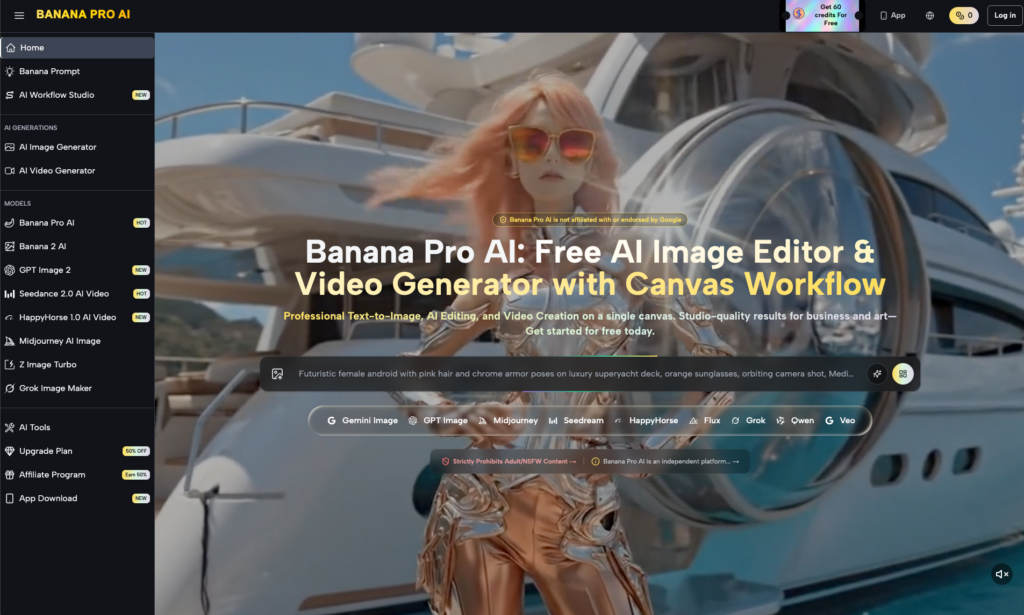
The current bottleneck in AI-driven content production isn’t the speed of generation; it is the drift of identity. When a creative team is tasked with scaling a campaign for a product like Nano Banana, the initial excitement of generating 50 variations in ten minutes quickly gives way to the realization that the product looks like three different versions of itself across those assets. One generation has the sleek, matte finish of the original design, while the next—destined for a TikTok ad—looks overly saturated or fundamentally restructured by a different model’s latent space.
For teams operating at scale, the goal isn’t just to “make images.” It is to maintain a coherent brand story across disparate channels—LinkedIn carousels, Instagram Stories, landing page heroes, and programmatic display ads. Achieving this requires moving away from the “lottery” of isolated prompting and toward a structured, multi-model pipeline that leverages a central studio environment like Banana AI to act as the creative anchor.
The Fragmentation Risk in Rapid Asset Generation
Scaling visual assets often reveals the fragility of text-to-image prompts. When you are generating assets for Nano Banana, a prompt that works perfectly in a 1:1 aspect ratio for Instagram might fail completely when adjusted to a 16:9 cinematic shot for a website header. This “prompt drift” occurs because models interpret spatial relationships and lighting differently as the canvas size or the specific model architecture changes.
If a team relies solely on text-only prompting, they face a lack of subject persistence. In a batch of 100 assets, the Nano Banana might start appearing with different hardware textures or inconsistent branding placement. This fragmentation is more than a minor aesthetic annoyance; it erodes brand trust. If the product looks different in the ad than it does on the landing page, the user experiences a subconscious friction that can lower conversion rates.
Furthermore, most teams struggle with the limitation of “vibe-matching.” Trying to replicate the specific cool-toned, industrial lighting of a successful “Seed Asset” across fifty other generations by just using words is an exercise in diminishing returns. Without a centralized workflow, the creative output becomes a collection of high-quality but unrelated images rather than a unified campaign.
Orchestrating Model Selection for Channel-Specific Needs
Modern content workflows are rarely mono-model. Within a platform like Banana AI, teams have access to various engines, each with distinct strengths that suit specific parts of a campaign funnel.
For the core “hero” shots of the Nano Banana—the images that will live on the primary landing page—GPT Image 2 is often the tactical choice. Its strength lies in high-fidelity detail and adherence to complex spatial instructions, making it ideal for the high-resolution, static images where every pixel is scrutinized. In contrast, when the team needs to generate 20 variations of a social media background where the “vibe” is more important than the exact geometric precision of every shadow, models like Midjourney or Gemini 3.1 Flash provide a faster, more stylized output that resonates better with the fast-paced consumption of social feeds.
The key to consistency here is selecting one model as the “visual anchor.” If Gemini 3 Pro is chosen for the primary product shots, its specific way of rendering light and texture should inform the prompts used for the auxiliary models. It is important to note, however, that even with the same seed and prompt, different models will never produce an identical twin. There is a persistent uncertainty in how different architectures handle “Nano Banana” as a concept, often necessitating a human editor to prune the outliers before they reach the final stage.
From Seed to Scale: The Batch Generation Workflow
A professional workflow begins with the creation of the “Seed Asset.” This is a single, approved generation that defines the color palette, the material properties of the Nano Banana, and the overall atmospheric lighting. Once this seed is locked, the team can move into batch generation.
- Structural Reference: Instead of writing 50 new prompts, the team uses the Seed Asset as an image-to-image or structural reference. This ensures the geometric proportions of the product remain stable across different environments.
- Aspect Ratio Mapping: The pipeline must account for the specific needs of each channel. A common pitfall is generating everything in 1:1 and then cropping. This loses the intentional composition that AI can provide. Instead, the workflow should involve specific generation runs for 9:16 (Stories), 16:9 (Web), and 4:5 (Feeds), using the Seed Asset to maintain coherence.
- Variable Environmental Prompting: While the product stays consistent, the environment changes to fit the channel. A LinkedIn asset might place the Nano Banana in a professional office setting, while a TikTok variation might place it in a high-energy, neon-lit creative studio.
Despite these steps, there is a technical trade-off between generation speed and pixel depth. During high-volume production, some assets will inevitably feature artifacts—odd shadow placements or slightly blurred edges—that require a second pass in a dedicated editor.
Unifying the Batch with Precision Editing
Raw AI generations, regardless of the model used, are rarely ready for high-stakes deployment. They are the “rough cuts.” To bridge the gap between a “good AI image” and a “brand-ready asset,” the AI Photo Editor becomes the most critical tool in the pipeline.
The consistency gap is usually closed in the post-generation phase. For instance, if a batch of 20 images features slight variations in the Nano Banana’s logo placement, the AI Image Editor allows a designer to perform “In-Painting” to fix the logo across all assets without re-generating the entire image. This level of granular control is what separates hobbyist creators from professional teams.
Furthermore, the AI Photo Editor is essential for unifying the color grade of a campaign. If ten images were generated in a bright morning light and ten were generated in a warmer sunset glow, the editor can be used to apply consistent LUT-style adjustments or lighting corrections. This ensures that when a user clicks an ad and lands on a product page, the visual transition is seamless. The AI Photo Editor also handles the removal of common AI artifacts—like nonsensical text or distorted background objects—that would otherwise distract the viewer.
Operational Limits and the Human-in-the-Loop Requirement
It is vital to maintain a sense of realism regarding what these tools can do autonomously. We are not yet at a stage where a team can press a single button and receive 100 perfectly consistent, brand-accurate assets.
One significant limitation is “product persistence” in radically different lighting or extreme angles. If you ask an AI to show the bottom of the Nano Banana when all your seed assets show the front, the model will “hallucinate” what it thinks the bottom looks like. Unless you have provided a comprehensive set of reference images, the AI’s guess may deviate from the actual product design. This is a moment of necessary caution: AI is an extrapolator, not a perfect replicator.
Another uncertainty lies in the ephemeral nature of model weights. A prompt that works perfectly today on Gemini 3 Pro might produce slightly different results in a month if the underlying model is updated or refined. This makes “prompt libraries” less permanent than traditional design style guides.
Finally, the most important component of the pipeline is the “Creative Ops” lead. While Banana AI provides the engine and the AI Photo Editor provides the refinement tools, a human must still evaluate the emotional resonance of the assets. AI can generate a technically “correct” image of Nano Banana, but it cannot yet fully grasp the subtle cultural nuances that make a specific image “right” for a specific audience at a specific moment. The human-in-the-loop is not just a quality control check; they are the arbiter of the brand’s soul in an increasingly automated environment.